


A dietitian personal trainer is a dual-credentialed professional who holds both registered dietitian (or nutritionist) credentials and certified personal training qualifications, allowing them to design integrated nutrition and fitness plans tailored to your unique goals. This combined expertise means you get coordinated guidance on what to eat and how to move, with each element reinforcing the other instead of working at cross-purposes.
Most people discover the value of this approach after struggling with conflicting advice. Your trainer might push high-intensity workouts while your dietitian recommends a low-carb plan that leaves you exhausted in the gym. Or your personal nutrition coach creates a beautiful meal plan that doesn’t account for your training schedule, leaving you either overfed on rest days or depleted during workouts.
When one person understands both sides of your wellness equation, they can adjust your macros on heavy training days, time your meals around workouts for better performance and recovery, and spot patterns that separate professionals might miss. If your energy crashes midway through sessions, they’ll know whether to look at your pre-workout nutrition, your sleep quality, your overall calorie intake, or your exercise intensity.
This integrated approach particularly benefits people with specific health conditions (like diabetes or thyroid issues), those following plant-based diets who need careful protein timing and nutrient planning, and anyone who’s tired of playing telephone between two professionals who’ve never met.
The challenge? Finding someone truly qualified in both areas takes research. Many fitness trainers take weekend nutrition courses and call themselves nutrition experts, while some dietitians hold personal training certifications but rarely step into a gym. You need to verify credentials, understand what this professional can realistically offer, and determine whether the investment makes sense for your situation.
What a Dietitian Personal Trainer Actually Does (And Why It Matters)

A dietitian personal trainer combines two distinct professional credentials into one powerful partnership for your health. This person holds both a Registered Dietitian Nutritionist (RD or RDN) credential and a certified personal training certification, meaning they’ve completed extensive education in both clinical nutrition science and exercise physiology. While one professional helps you understand what to eat and another guides how to move, a dietitian personal trainer sees these as inseparable parts of the same puzzle.
The difference shows up immediately in how they work with you. When you split your care between a traditional dietitian and a personal trainer, you’re essentially playing telephone between two professionals who may never communicate. Your trainer might push a high-protein regimen without knowing your digestive sensitivities. Your dietitian might create meal plans that leave you exhausted halfway through your workouts. You become the coordinator, trying to make sense of conflicting advice that wasn’t designed to work together.
A dietitian personal trainer eliminates that gap entirely. They design your nutrition plan with your training schedule already in mind. They adjust your workout intensity based on how your body responds to different foods. When you mention feeling sluggish during morning runs, they can immediately connect it to your pre-workout fuel and adjust both your eating timing and your training load. There’s no translation needed, no mixed messages, and no wasted time repeating your story to multiple people who only see half the picture.
This integrated approach creates something more valuable than convenience. It builds a truly personalized system where every recommendation reinforces the others, making your progress feel less like pushing a boulder uphill and more like finally having all your efforts pointed in the same direction.
The Missing Link in My Personal Nutrition Journey
I still remember sitting in my car after a particularly exhausting gym session, crying over a protein shake I didn’t want to drink. My trainer had just lectured me about needing 150 grams of protein daily, most of it from animal sources, to see real results. Meanwhile, my dietitian had carefully planned my plant-based meals around digestive health and nutrient density, but never asked when I worked out or what kind of training I was doing.
The disconnect was crushing. I’d finish an intense morning workout and follow my meal plan exactly, only to feel dizzy and depleted by noon. My trainer would shake his head at my “inadequate” diet. My dietitian would adjust my fiber intake without understanding why I felt so fatigued. Nobody seemed to see the whole picture of what my body actually needed.
The worst part? I started lying to both of them. I’d tell my trainer I was eating more animal protein than I was. I’d tell my dietitian my workouts were lighter than they actually were. I was trying to please everyone while feeling more disconnected from my own body than ever before.
The breaking point came during a half-marathon I’d trained months for. I followed my meal plan perfectly that morning, eating what my dietitian recommended. But she didn’t know I’d be running 13 miles. By mile eight, I bonked hard. My legs felt like concrete. My vision got spotty. I had to walk most of the final miles.
Sitting on the curb afterwards, wrapped in that crinkly foil blanket, something clicked. This wasn’t about choosing between nutrition expertise and fitness knowledge. I needed someone who understood both, who could see how the quinoa bowl I ate for breakfast would fuel my long run, how my Tuesday yoga class required different nutrition than my Thursday strength training.
I needed a professional who wouldn’t make me choose between my plant-based values and my athletic goals. Someone who understood that food and movement aren’t separate categories of health, they’re partners in the same dance. That realization changed everything about how I approached finding the right support for my journey.
How a Dietitian Personal Trainer Personalizes Your Approach
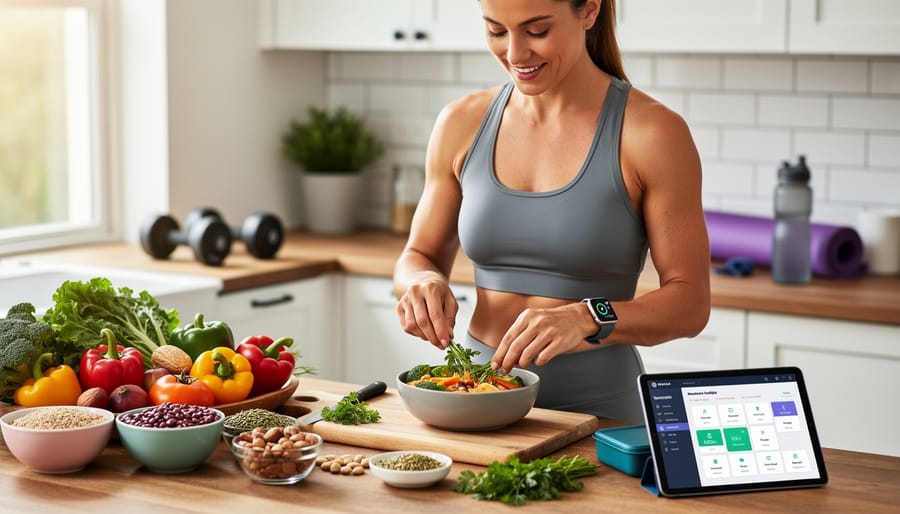
Beyond Macros: Understanding Your Body’s Unique Needs
When I first started tracking macros, I thought I’d unlocked some kind of secret code. Hit my protein target, stay within my calorie range, and everything would fall into place. Except it didn’t. I felt sluggish during morning workouts, bloated after meals, and constantly hungry even when the numbers said I’d eaten enough.
A dietitian personal trainer helped me understand what those macro calculations couldn’t see. They asked questions my fitness app never considered: When do you feel most energized? How’s your digestion after beans versus tempeh? Do you sleep well after evening workouts? What foods make you feel satisfied for hours versus hungry again in an hour?
This is where the dual expertise makes all the difference. They examined how my body actually responded to food timing around workouts, not just whether I’d consumed enough protein overall. We discovered that eating a small carb-rich snack an hour before training dramatically improved my performance, while saving most of my protein for post-workout helped my muscles recover without leaving me feeling weighed down.
They also connected dots I’d never considered. My afternoon energy crashes weren’t about calories, they were about iron absorption. My bloating wasn’t about eating too much, it was about combining certain foods that my digestive system struggled to process together. Understanding these individual patterns transformed how I planned meals, and suddenly those macro targets became tools that actually worked with my body instead of against it.
Creating Sustainable Habits, Not Quick Fixes
I’d spent years chasing the next diet trend or workout challenge, always convinced this would be the thing that finally stuck. Inevitably, I’d burn out within weeks, defeated and back to square one. What I discovered working with a dietitian personal trainer was fundamentally different: they weren’t interested in overhauling my entire life overnight. Instead, they focused on small, meaningful shifts I could actually maintain.
We started with one simple change, adding a protein-rich snack after my morning workouts. That’s it. No meal plan overhaul, no sudden shift to eating six times a day, no banning foods I loved. Once that became automatic, we built on it. This personalized nutrition approach taught me that sustainable change happens in layers, not leaps.
The workout side followed the same philosophy. Rather than punishing HIIT sessions that left me dreading the gym, we found movement I genuinely enjoyed and could fit into my actual schedule. Some weeks that meant three strength sessions. Other weeks, just two plus walks. The flexibility didn’t feel like failure anymore, it felt like real life.
What surprised me most was how this patience rebuilt my self-trust. I learned to listen when my body needed rest, when it craved certain foods, when energy felt low. I stopped viewing my needs as obstacles to overcome and started seeing them as valuable information. That shift changed everything.
When Plant-Based Eating Meets Athletic Performance

I used to believe the myth that plant-based eating couldn’t support serious athletic goals. My first trainer certainly did. He’d look at my food journal and shake his head, insisting I needed animal protein to build strength. Working with a dietitian personal trainer who understood both plant-based nutrition and performance changed that narrative completely.
The breakthrough came when she mapped my training schedule against my meals. We discovered I was under-fueling before workouts and missing key recovery windows afterward. She showed me how to time nutrient-dense whole foods strategically, so my energy stayed steady and my muscles actually recovered.
For strength training days, we built meals around combinations that delivered complete proteins, lentils with quinoa, tempeh with brown rice, chickpeas with whole grain bread. Before early morning runs, I learned that a small portion of easily digestible carbs worked better than skipping food entirely. Post-workout, she taught me to pair protein-rich foods with carbohydrates to optimize muscle repair.
The practical shifts were surprisingly simple. I started exploring yam nutrition facts and discovered how their complex carbohydrates fueled longer training sessions without the crash I got from processed energy bars. For hot summer workouts, I learned about hydration with watermelon which provided electrolytes and natural sugars alongside fluid.
What made this approach work was having someone who understood both sides of the equation. My dietitian personal trainer didn’t just tell me what to eat. She explained why specific foods mattered for the type of movement I was doing, when to eat them, and how to adjust portions based on training intensity. She respected my plant-based values while optimizing my athletic performance, proving the two weren’t mutually exclusive.
What to Look for When Choosing Your Dietitian Personal Trainer
Finding the right dietitian personal trainer starts with verifying their credentials. You’re not just looking for someone with fitness knowledge or nutrition advice, you need dual expertise backed by proper certification. Confirm they hold both RD (Registered Dietitian) or RDN (Registered Dietitian Nutritionist) credentials and a recognized personal training certification like ACE, NASM, or NSCA. These aren’t just letters after a name; they represent thousands of hours of education, supervised practice, and ongoing professional development.
Beyond basic credentials, consider specializations that match your specific needs. If you follow a plant-based diet, seek someone with demonstrated expertise in vegan or vegetarian nutrition. Athletes or active individuals benefit from professionals with sports nutrition credentials. Those managing health conditions need someone experienced in medical nutrition therapy alongside fitness programming.
Here’s a practical approach to finding your match:
- Search professional directories like the Academy of Nutrition and Dietetics or certification body databases to find credentialed professionals in your area or offering virtual services.
- Review their website, social media, and client testimonials to understand their philosophy, approach, and whether they work with people like you.
- Schedule initial consultations with two or three candidates to compare how they communicate and whether you feel understood.
- Ask specific questions about their experience with your goals, their assessment process, how they integrate nutrition and training, and what ongoing support looks like.
- Trust your gut about the relationship, you need someone who listens without judgment and makes you feel empowered, not intimidated.
During consultations, pay attention to whether they ask thoughtful questions about your lifestyle, food preferences, past experiences, and what’s worked or failed before. The right professional sees you as a whole person with unique needs, not a template to fill. They should explain their process clearly, discuss realistic timelines, and be transparent about costs and commitment levels. This partnership works best when built on mutual respect and clear communication from the start.
Real-Life Impact: How This Approach Transformed My Relationship with Food and Fitness
Working with a dietitian personal trainer didn’t just change what I ate or how I moved. It fundamentally shifted how I related to my body and my choices.
Within the first month, I noticed I was waking up genuinely energized instead of dragging myself out of bed. My afternoon slumps disappeared because I’d learned how to time my meals around my workouts and daily rhythms. Recovery stopped feeling like a weeklong ordeal. My muscles weren’t constantly sore, and I started looking forward to training sessions instead of dreading them.
The most profound change was developing what I can only describe as food peace. I stopped obsessing over every meal or feeling guilty when I ate something “off plan.” My dietitian personal trainer helped me understand that a sweet potato before a morning run served a purpose just as much as a recovery smoothie afterward. Food became fuel and pleasure, not a source of anxiety.
I also stopped forcing myself through workouts my body wasn’t ready for. When I felt depleted, I learned to recognize it as a signal to adjust my eating or rest, not push harder. This self-awareness felt revolutionary after years of ignoring what my body was telling me.
One practical shift that made a huge difference: adding a post-workout bowl that combined plant-based protein with complex carbs and anti-inflammatory foods. I’d blend frozen berries, a scoop of hemp or pea protein powder, a handful of spinach, half a banana, and a tablespoon of ground flaxseed with unsweetened almond milk. Sometimes I’d add a pinch of cinnamon and a few dates for natural sweetness. It took five minutes to make, tasted like dessert, and gave my body exactly what it needed to repair and rebuild.
These weren’t minor tweaks. They were fundamental changes that made fitness feel sustainable and eating feel intuitive, finally working together instead of constantly at odds.
Your health journey is too important to navigate in fragments. You deserve support that sees all of you, not just the calories you consume or the reps you complete, but the whole person trying to feel strong, energized, and at home in your body.
Working with a dietitian personal trainer showed me what’s possible when nutrition and movement work together instead of competing for your attention. It taught me that sustainable change doesn’t come from rigid meal plans or punishing workouts. It comes from understanding how food fuels your body, how movement builds your strength, and how both can align with who you are and what you value.
If you’re tired of conflicting advice, if you’re ready to stop choosing between your nutritional needs and your fitness goals, consider finding someone who understands both. Look for a professional who asks about your life, not just your measurements. Someone who respects your plant-based values, your energy levels, your schedule, and your story.
You’re not a project to be fixed. You’re a person deserving of integrated, compassionate care that honors your body and supports your journey forward.